Gardens · Contemporary Art · Glass
Yukito Nishinaka’s Glass Karesansui
Creating the Traditions of the Future
When you see Tsunagaru (Eternal Affinity) at Honen-in in Kyoto, it is easy to feel that the glass was always meant to be there.
In front of the temple’s thatched gate, thick, transparent glass forms stand among moss, gravel, old trees, and stone walls. They have the presence of landscape stones, yet light passes through them. Some suggest ice, others water or transparent minerals rising from the earth. Sky, tree shadows, and the green of nearby moss enter the glass. The work changes as the viewer moves, and as sunlight and weather shift around it.
The more naturally the glass merges with its surroundings, the easier it is to forget that this relationship did not exist before.
The real challenge was to connect the glass with the story of the site, its light, the movement of visitors, and the ideas behind the work. Nishinaka first saw that glass might have a place in the Japanese garden. Over years of making, he turned that intuition into a fully realized artistic form.
At Honen-in, glass does not stand in for stone. It finds its own place and purpose in karesansui, the Japanese dry landscape garden.

In this essay
How an Idea Became a Form
Yukito Nishinaka was born in Wakayama City in 1964 and graduated from Hoshi University of Pharmacy. He later worked at Kagami Crystal Co., Ltd., studied sculpture and glass at California College of the Arts, served as a teaching assistant at the Toyama City Institute of Glass Art, and established his own studio in 1998.
He trained first in pharmacy and analytical chemistry, then entered industrial glassmaking, and ultimately moved into sculpture and contemporary art. That path taught him to understand glass at once as matter, technique, space, and perception.
Nishinaka has said that analytical chemistry taught him to trace a visible phenomenon back to the components actually at work behind it—to “see what cannot be seen.” Through the tangible, visible material of glass, his art approaches the inner life, the transformations of life itself, and the relationship between the individual and the universe.
Glass truly entered the garden in 2014.
That year, Nishinaka was invited to exhibit at the Tamesaburo Memorial Museum, an annex of the Furukawa Art Museum in Nagoya. Encountering its sukiya-style architecture and established Japanese garden, he began with one idea: to bring “glass as light” into the garden.
He set glass into stepping stones and fences, allowing visitors to encounter it through changing sunlight as they moved through the garden. The luminous material could sharpen their awareness of the rest of the garden: the sound of the waterfall, the scent of trees, and the color of moss.
In 2015, he presented Garden of Light at Nihombashi Takashimaya. Glass forms modeled after a chōzubachi, or water basin, and stepping stones created an indoor Japanese garden. The relationship between glass and garden gradually expanded from individual objects and sections of a path into an entire space.
A large recycled-glass installation in 2017 took ideas of life and renewal to a larger scale. The work drew attention for its engagement with sustainability and resource reuse. Through recycled glass, Nishinaka continued to explore human life, the inner self, and the relationship between the individual and the universe.
Across these works, the relationship between glass and garden took fuller shape. It came to include light, movement, space, the material’s former life, melting and renewal, and the stories already present at a site.
In 2019, these ideas came together in Tsunagaru at Honen-in.
Glass Enters Honen-in’s Three-Century Landscape
Honen-in traces its origins to a thatched retreat associated with the Buddhist teacher Hōnen in the Kamakura period. The foundations of the present temple complex were established in 1680. Its approach already held more than three centuries of religious practice, spatial history, and lived memory.
In 2019, Nishinaka donated Tsunagaru to Honen-in as a permanent glass karesansui installation.
The work extends roughly forty meters along the approach to the thatched gate. Discarded bottles were collected, sorted, and cleaned, then remelted at approximately 1,400 degrees Celsius and cast into new forms. Glass, moss, and sand evoke a landscape of mountains and water, although the work contains no actual water.
Honen-in has its own history, scale, and atmosphere. For glass to enter this place, it had to live with the gate, terrain, moss, trees, and light already there.
Nishinaka’s glass retains the character of a contemporary material. Its thickness and height give it a strong physical presence, while its transparency draws moss, tree shadows, and sky into its interior. Honen-in’s existing landscape never recedes into a backdrop; it actively participates in what the glass becomes.
Visitors pass beside the glass as they follow the approach. With every step, pause, and backward glance, their distance from the work—and their view of it—changes.
From a distance, the glass resembles garden stones. Up close, bubbles, bottle mouths, and layers within the material emerge. Turn around, and a piece that had seemed to stand alone recombines with the gate, trees, gravel, and the rest of the installation.
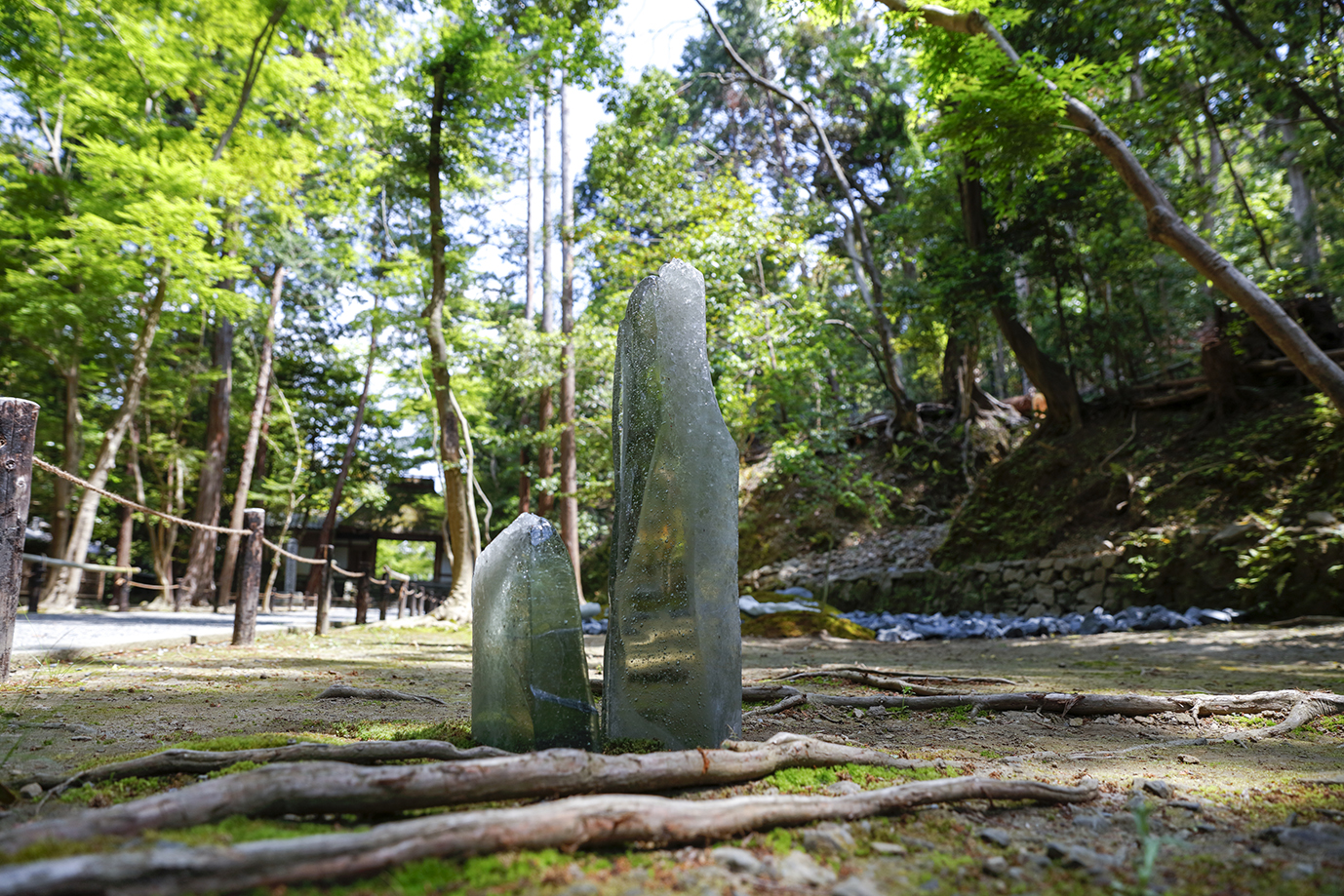
Tsunagaru extends far beyond a group of glass forms. The approach, terrain, moss, trees, light, and the movement of visitors all belong to the work.
In 2018, while Tsunagaru was still taking shape as an idea, a major storm known in Japan as Typhoon No. 21 brought down many trees along Honen-in’s approach, cemetery, and garden. From the undamaged gate, Nishinaka looked across the devastated path. Regeneration, already central to his work, now confronted him as the task of an actual place.
Honen-in also changed the way he approached the material.
Nishinaka has recalled that he once placed great emphasis on colors and forms determined by the artist. Working in a place shaped by more than three centuries of time, he began to search for “forms for the site and the material.” He accepted the bends and variations that arose naturally in the making process and eventually allowed the material itself to help determine the work’s form.
Nishinaka brought glass into Honen-in. Honen-in, in turn, changed the way he worked with glass.
Stone Receives Light; Glass Lets Light Enter the Garden
The expression of a traditional stone arrangement comes primarily from form, direction, weight, surface, and shadow. Sunlight falls upon a stone and reveals its edges, texture, and outline.
Glass has something stone does not: an interior.
Light enters the glass, passes through bubbles, thickness, and irregular forms, and then falls upon the surrounding gravel and moss. The viewer sees the glass and also sees the garden through it.
Stone receives light; glass lets it enter the garden.
Within the composition, these glass forms act like landscape stones, establishing height, direction, distance, and points of focus. To the eye, they hover between water, ice, and light.
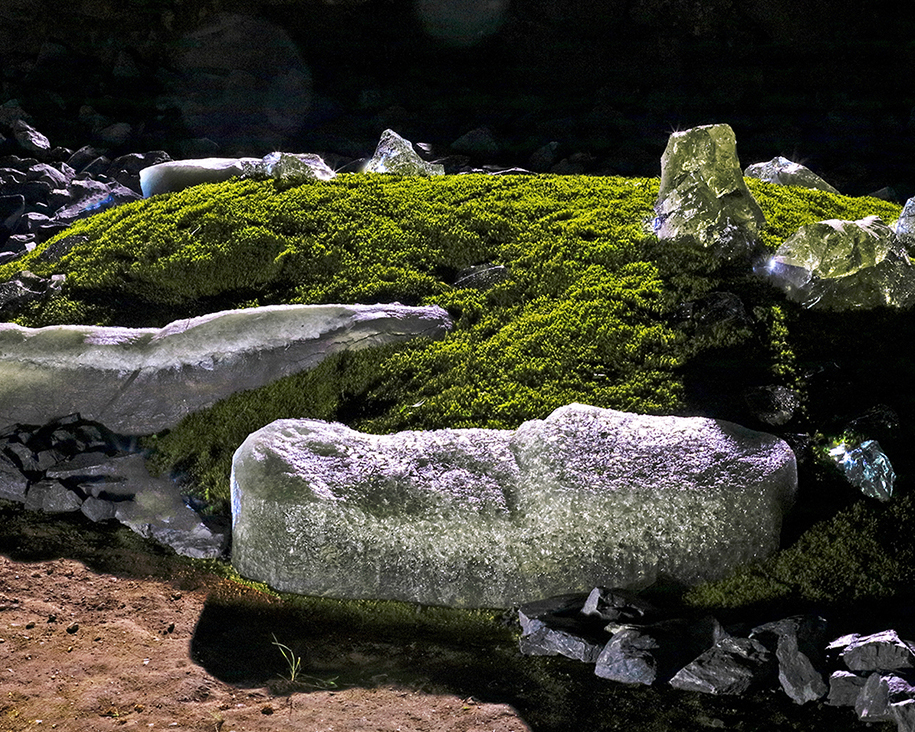
From transparency and refraction, bubbles and traces of melting, Nishinaka developed a garden language specific to glass.
Glass also brings time into the work itself.
In the morning, at noon, under cloud, after rain, and in moonlight, the glass changes in outline, transparency, and color. At times it is a weighty physical object. At others it becomes a column of light or nearly dissolves among the trees. As light moves, the glass itself seems to flow through the garden.
While making Tsunagaru, Nishinaka came to feel ever more strongly that glass is light. He compared sunlight entering the forms to a spring that would never run dry. Reflected moonlight gives the glass garden another expression that natural stone cannot produce.
Karesansui uses stone and gravel to summon water in the imagination. Through transparency, refraction, and moving light, Nishinaka’s glass gives another sense of flow to a garden without running water.
The Glass Remembers Being a Bottle
The time carried by natural stone often began long before human beings appeared.
Nishinaka’s glass carries a different kind of time. It was once a sake bottle, a beverage bottle, or another everyday container—held in someone’s hand, placed on a table, then discarded after serving its purpose.
Nishinaka deliberately preserves some bottle bases and threaded necks. These traces let the glass retain memories of its life among people. Even at Honen-in, the material remembers what it was before.
Recycling becomes part of the work’s meaning. The material’s former purpose, its fate as refuse, the process of remelting, and its new place in the garden all remain within Tsunagaru.
The work’s cosmology was also inspired by a conversation with Shinsho Kajita, the abbot of Honen-in: each person is a small universe, connected at once to the 13.8-billion-year-old cosmos and to other forms of life. The passage of glass from container to molten material and back into form links it to cycles of life, matter, and time.
Glass takes form in intense heat. Even after a work is finished, it can return to a molten state and become something else. In this repeated transformation, Nishinaka sees a metaphor for life’s emergence, disappearance, and renewal.
At Honen-in, recycled glass acquires a new form while keeping evidence of its earlier life in the human world.
From YOBITSUGI to a Garden
This attention to fracture, material memory, and renewal also appears in another of Nishinaka’s defining bodies of work: YOBITSUGI — Shatter to be Reborn.
He shatters glass vessels he has made, then recombines fragments from different pieces into new works. Cracks and joints remain visible, becoming each work’s most pronounced features. The broken vessel does not return to what it was. Reconnected, it takes on another form.
YOBITSUGI and the glass karesansui differ in scale, but the same understanding of material runs through both.
In YOBITSUGI, breaking, joining, and renewal take place within a vessel. In the glass karesansui, the same thought enters a garden. Bottles that have completed their original use are remelted into forms with the presence of landscape stones, transparent columns of light, and a landscape unfolding along the temple approach.
One work continues to exist with its cracks. A collection of discarded bottles enters the garden carrying memories of everyday life.
Seen this way, Tsunagaru and YOBITSUGI follow the same line through Nishinaka’s practice. Both ask how something can pass through destruction and transformation, then continue in another form.
The glass karesansui carries Nishinaka’s thinking about fracture, material memory, and renewal beyond the scale of the vessel and into architecture, garden, and human movement.
Between Hashintei and the Glass Karesansui
The public dialogue between Yukito Nishinaka and garden designer Chisao Shigemori began in 2014.
That year, Nishinaka held the glass exhibition Dentō o Yobi, Mirai o Tsugu (“Calling Tradition, Carrying the Future”) at the Tamesaburo Memorial Museum. He placed his work within sukiya-style architecture and a Japanese garden, and invited Shigemori to trace the development of the Japanese garden: from monumental stones and the Zen monk and garden maker Musō Soseki to Mirei Shigemori and the gardens of the future.
Nishinaka wondered how a garden designer would view the experiment.
Before seeing it, Chisao Shigemori had also worried that glass in a Japanese garden might amount to novelty for its own sake. Once inside the garden, however, he was struck by how naturally the work sat in its surroundings. The glass was not stone, but it carried something of natural stone’s character. It even reminded him of the Fujito Stone at Sanbō-in, Daigoji.
He ultimately described Nishinaka’s experiment in one sentence:
「伝統を踏まえた上での次なる一歩。」“A next step grounded in tradition.”
The remark identifies what gives Nishinaka’s work its coherence. Within the composition, glass takes on the role of the garden stone without becoming a substitute for it. The material keeps its transparency, bubbles, traces of melting, and the history of the bottles from which it was made.
Seven years later, NHK WORLD’s Core Kyoto brought them together again in “Conversations: A Landscape Gardener and a Glass Artist,” an episode centered on the “re-creation of beauty.”
This time, the program juxtaposed Tsunagaru, the glass karesansui at Honen-in, with Hashintei at Komyo-in, designed by Mirei Shigemori. The two gardens use different materials and belong to different eras, yet they ask a related question across time: How can tradition continue to grow in the present without merely repeating old forms?
Hashintei brings Mirei Shigemori’s relationship with tradition into the conversation.
Mirei Shigemori’s avant-garde gardens grew from a close study of tradition. He surveyed and studied numerous historic gardens, developed a deep understanding of stone arrangements, spatial organization, and garden history, then built his own forms on that foundation. That foundation gave rise to innovation.
Chisao Shigemori begins with stone, earth, garden history, and space as a whole.
Yukito Nishinaka begins with glass, light, fracture, melting, and regeneration.
They work with very different materials, but they face the same question:
How can a new form arise from tradition without copying the past?
For Chisao Shigemori, the answer remains between stone and earth.
For Yukito Nishinaka, it begins with glass itself.
Transparency, refraction, bottle necks, fractures, and traces of melting were not part of the traditional garden’s established vocabulary. By engaging the light, water, time, nature, and human perception that have long concerned karesansui, these qualities enter the garden’s language.
Nishinaka’s glass karesansui answers that question through another material.
“I Create the Traditions of the Future”
I once spoke with Yukito Nishinaka about his glass karesansui. He said:
「私は未来の伝統を創ります。」“I create the traditions of the future.”
At Honen-in, the statement feels exact.
Transparency, refraction, and the ability to be melted again are inherent properties of glass. Nishinaka first saw how those qualities might enter a Japanese garden. Through years of work, he connected them with light, stepping stones, fences, sand, moss, trees, human movement, material memory, cycles of life, and the story of a place.
From his 2014 presentation of glass as “light” in a Japanese garden, through Garden of Light and the large recycled-glass installation, to Tsunagaru in 2019, the initial idea became a space people could enter—one that changes with the light and can carry the time and story of an old temple.
The idea came first. Nishinaka then made it whole.
Honen-in gave the work deeper meaning. Glass keeps the character of a contemporary material while connecting with the approach, moss, trees, and more than three centuries of time. A new form enters the history of the Japanese garden, while the old site acquires a new span of time that is still unfolding.
Yukito Nishinaka has created a language of karesansui belonging to glass itself, shaped by the story and ideas of a place.
It is a creative stance directed toward the next era.
Along the approach to Honen-in, one of the “traditions of the future” Nishinaka speaks of has already begun to gather its own time.
Sources and Notes
- Yukito Nishinaka official website | Profile: education, professional background, and major bodies of work. The Japanese profile confirms Wakayama City as his birthplace.
- Yukito Nishinaka official website | Exhibition at the Tamesaburo Memorial Museum: the 2014 exhibition that brought “glass as light” into sukiya-style architecture and a Japanese garden. The English rendering of the Japanese exhibition title in this article is by Tang-Yu Life.
- Yukito Nishinaka official website | Garden of Light: an exhibition record of the indoor Japanese garden formed by glass works and stepping stones. The English title is a translation of Hikari no Niwa.
- Yukito Nishinaka official website | Eternal Affinity at Honen-in: the site, recycled glass, sunlight and moonlight, and traces retained in the material.
- Yukito Nishinaka official website | Hoshi University of Pharmacy alumni article: analytical chemistry, recycled glass, cycles of life, typhoon damage at Honen-in, and the effect of place and material on Nishinaka’s practice.
- Yukito Nishinaka official website | YOBITSUGI — Shatter to be Reborn: the artist’s account of YOBITSUGI.
- Yukito Nishinaka official website | Core Kyoto: a record of Nishinaka and Chisao Shigemori’s participation in the NHK WORLD episode “Conversations: A Landscape Gardener and a Glass Artist.”
- Honen-in | History: the temple’s origins and the establishment of the present complex in 1680.
- TEAM TANIYON | Yukito Nishinaka and Shinsho Kajita: their conversation on Tsunagaru and its cosmological view.
- Yukito Nishinaka’s blog | Conversation with Chisao Shigemori: Shigemori’s response to glass in the Japanese garden and his description of the work as “a next step grounded in tradition.”
- Nishinaka’s statement 「私は未来の伝統を創ります。」 was shared directly with Tang-Yu Life. The English translation in this article is by Tang-Yu Life.