The Japan Hearn Wrote in English
Japan remembers him as Koizumi Yakumo. When he moved into the Matsue house, however, he was still Patrick Lafcadio Hearn: born on the Greek island of Lefkada, raised in Ireland, and shaped by years of reporting and writing in Cincinnati, New Orleans, and Martinique. He reached Japan in 1890 and became a naturalised Japanese citizen in 1896.1
For English-language readers at the end of the nineteenth century, Hearn’s books opened windows onto parts of Japan that formal histories and travel guides rarely held still. The contents of Glimpses of Unfamiliar Japan move from a garden to a household shrine, women’s hair, an English teacher’s diary, local festivals, souls, ghosts, and the Japanese smile. In Kokoro, he said plainly that he wished to write about the “inner rather than the outer life of Japan.” His final large study, Japan: An Attempt at Interpretation, moved through the religion of the home, the Japanese family, Shinto, social organisation, education, and the pressures of modern industry.3
This was not a complete or neutral portrait of Japan—no single writer could offer one. Hearn was especially drawn to older customs, local beliefs, and forms of life he feared modernisation would erase. Yet that preference also gave his work its unusual scale. He could begin with a room, a plant, a sound, or a household habit, then follow it toward larger questions of family, memory, religion, and the relation between the visible and invisible worlds.
In a Japanese Garden is almost a miniature of that method. Hearn starts with a house and a few stones. Before long, the garden has become a way of reading the life around it.
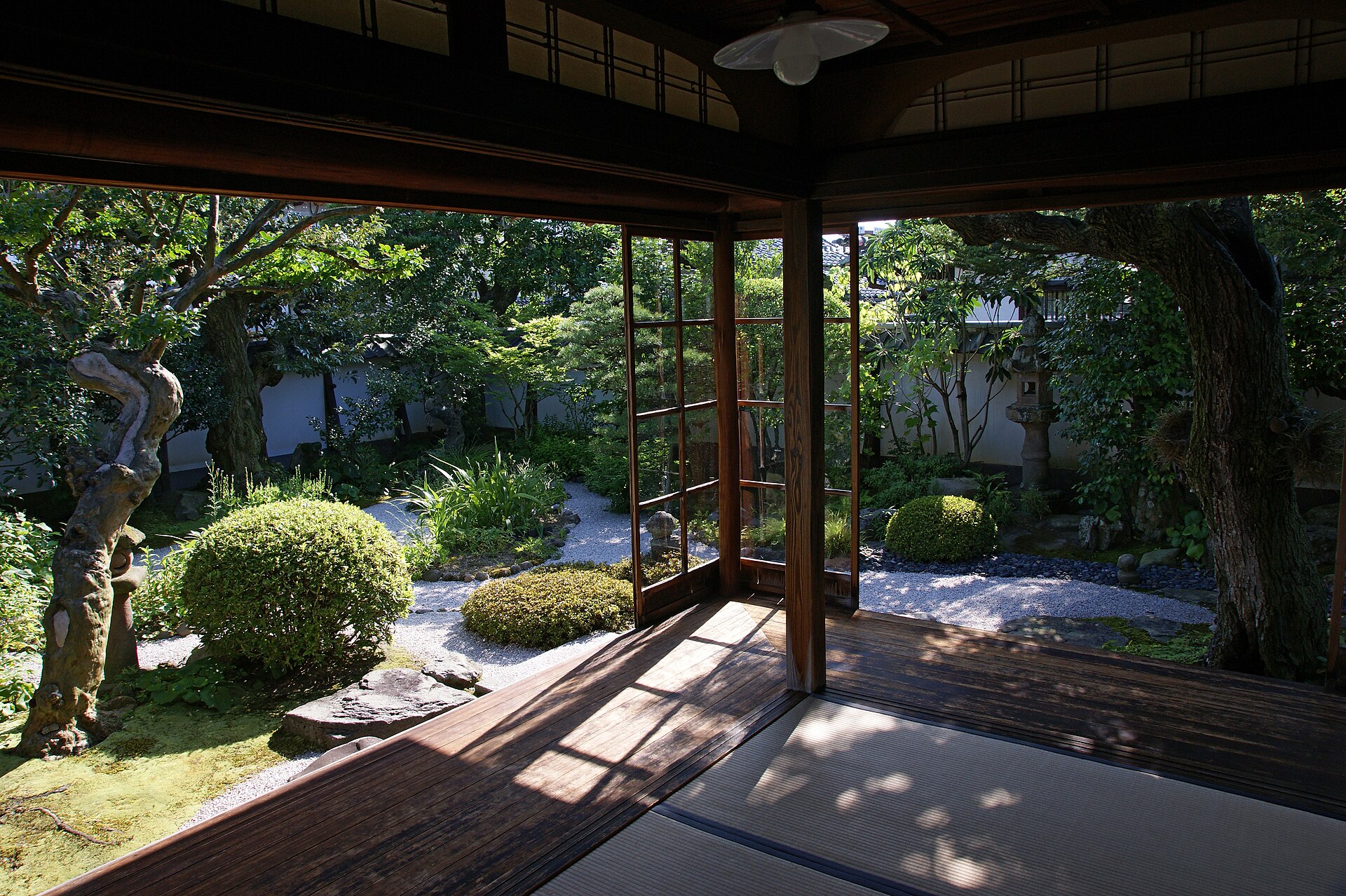
He had actively wanted to live in a samurai residence with a garden. In June 1891, he and Setsu moved into the former Negishi family residence near Matsue Castle. He lived there for about five months, until November, when he left to teach in Kumamoto. The garden lay on three sides of the house. On returning from school, he changed into Japanese clothing and looked out from the rooms and veranda in what the residence now describes as bliss.2
He was not visiting a celebrated temple garden for half an hour. He was living beside an ordinary domestic garden, returning to the same views day after day. That difference shaped everything he saw.
A Japanese Garden Is Not a Flower Garden
Hearn did not mean that flowers were absent. His Matsue garden held plum, cherry, iris, lotus, chrysanthemum, and other plants that marked the seasons. His distinction was between displaying flowers and composing a landscape.
A flower bed reaches its obvious climax when everything blooms. A garden has to remain convincing after the flowers have gone. The ground still rises and falls; stones retain their direction and weight; shadows move; water reflects a different sky; the spaces between things continue to work.
Hearn also observed that a Japanese garden had no fixed minimum size. It might cover acres, occupy a space only ten feet square, or be compressed into a shallow vessel in a tokonoma. Scale alone did not decide whether it was a garden. A few stones, plants, paths, and intervals could still suggest a coherent landscape.4
Hearn’s observations also raise a demanding question for garden design today. A small garden cannot rely on quantity. Every choice becomes more exposed: how close two stones stand, where a path pauses, what a room frames, how much unoccupied ground is needed for the eye to move from one element to the next.
The question is not how many things have been added, but whether the limited space has become a world with its own order.
Flowers catch attention first. Hearn placed the hardest lesson of the garden in something that never blooms.
Stones Have Character
To understand the beauty of a Japanese garden, Hearn wrote, one must first learn to understand the beauty of stones—not quarried blocks cut to specification, but stones shaped by nature.
A natural stone arrives with a history already written into it. Water has rounded one face; fracture has left another sharp. It has a centre of gravity, a direction, a surface that catches light in a particular way. One stone appears forceful when raised; another becomes stable only when laid low and partly buried.
Hearn called large stones the skeleton or framework of an old Japanese garden. Each was selected for the expressiveness of its form and for the work it had to perform in the composition. A similar-sized stone could not always take its place.4
From a garden-making site
I once watched the garden designer Chisao Shigemori adjust the same stone again and again: turning it slightly, raising it, lowering it, then burying a little more of its base. At one angle it looked like an object set on the ground. After a small turn and a few more centimetres of depth, it appeared to belong there.
The designer was not inventing a personality for the stone. He was reading the direction, weight, and expression it already possessed, then finding a position in which those qualities could become visible.
This changes the usual relation between design and material. The stone is not an obedient blank waiting to fit a drawing. The drawing must also answer to the stone.
Its character is never isolated. A stone appears heavier or lighter according to the open ground around it. Its direction becomes legible through the stone beside it. The interval between two stones can create tension, calm, or a sense of movement. What looks empty may be doing essential work.
If individual stones have character, the garden as a whole cannot be a neutral background.
A Garden Should Have a Temperament
Hearn did not reduce garden-making to the production of a beautiful view. Nature can feel joyful or solemn, severe or sweet, forceful or peaceful. A true garden, he argued, should allow such feelings to take shape in the person who experiences it.
He went further. Old gardens, he wrote, were made according to the character of their owners. A poet, a warrior, a philosopher, and a priest should not all inhabit the same garden.4
The idea is easy to miss today, when a garden is often treated as an exterior style applied after the building is designed. Hearn’s garden was closer to an atmosphere surrounding daily life. It had to answer the disposition of the person who lived beside it, and the rooms and veranda determined how that atmosphere entered the house.
A garden of calm is not made by adding a label that says “calm.” It emerges from the weight of stones, the pace of a path, the depth of shade, the amount of open ground, the sound of water, and the way all of these are encountered from a particular room.
This is why Hearn called a Japanese garden both a picture and a poem—“more a poem than a picture.” A picture preserves what appears before the eyes. A garden also works through what is not present all at once: changing light, accumulated memory, expectation, sound, and time.
Rather than continue with abstract theory, Hearn turned back to what happened around him.

Reggaeman · CC BY-SA 3.0
The Japan Beyond the Wall
At the end of the essay, Hearn described returning after five hours of teaching, exchanging his uniform for a Japanese robe, and sitting on the shaded veranda. The old walls seemed to shut out the city. Inside were birds, cicadas, and the occasional splash of a frog. Outside hummed the changed Japan of telegraphs, newspapers, and steamships.4
That contrast runs through much of his writing. Hearn arrived during rapid modernisation. He was fascinated by the new Japan, but he was often more intent on recording forms of knowledge that did not announce themselves as progress: what a plant meant to a household, how a local story changed the perception of a place, how memory remained present in ordinary life.
He feared that old samurai houses and gardens like this one would disappear, leaving later generations to know them only as dreams. More than 130 years later, the residence and its gardens remain in Matsue, and the views from the house still largely resemble those he knew.25
What is less easily preserved is the habit of attention that made the essay possible: returning to the same veranda, learning the voices of different cicadas, knowing where the rain collects, and recognising the animal that will probably visit again.
How Hearn Changes the Way We Look at a Japanese Garden
Hearn did not leave a checklist of recognisably “Japanese” objects. He left a sequence of questions.
- When the flowers fade, does the garden still hold together?
- Does each stone appear necessary, or could any similar stone replace it?
- What mood enters the adjoining rooms through light, shade, sound, and distance?
- What changes with rain, season, repeated use, and years of residence?
- What has become familiar enough to carry memory?
The depth of a Japanese garden does not come only from hidden symbols or rare materials. It comes from ordinary things having a precise place, a duration, and a relation to one another.
A photograph can prove that a garden looked beautiful on the day it was finished. It cannot prove that the place will continue to give something to the people who live beside it.
For Hearn, the garden became fully visible only after the house, the seasons, and its inhabitants had begun to know one another.