Japan’s first Nobel laureate in literature
Kawabata was born in Osaka in 1899. He lost both parents while still very young and was raised by his maternal grandparents. While studying at Tokyo Imperial University, he helped found the literary journal Bungei Jidai and became one of the leading writers associated with the New Sensationist movement. Snow Country established his place in Japanese literature during the 1930s; after the war, Thousand Cranes, The Sound of the Mountain, and The Old Capital carried his work to a much wider international readership.
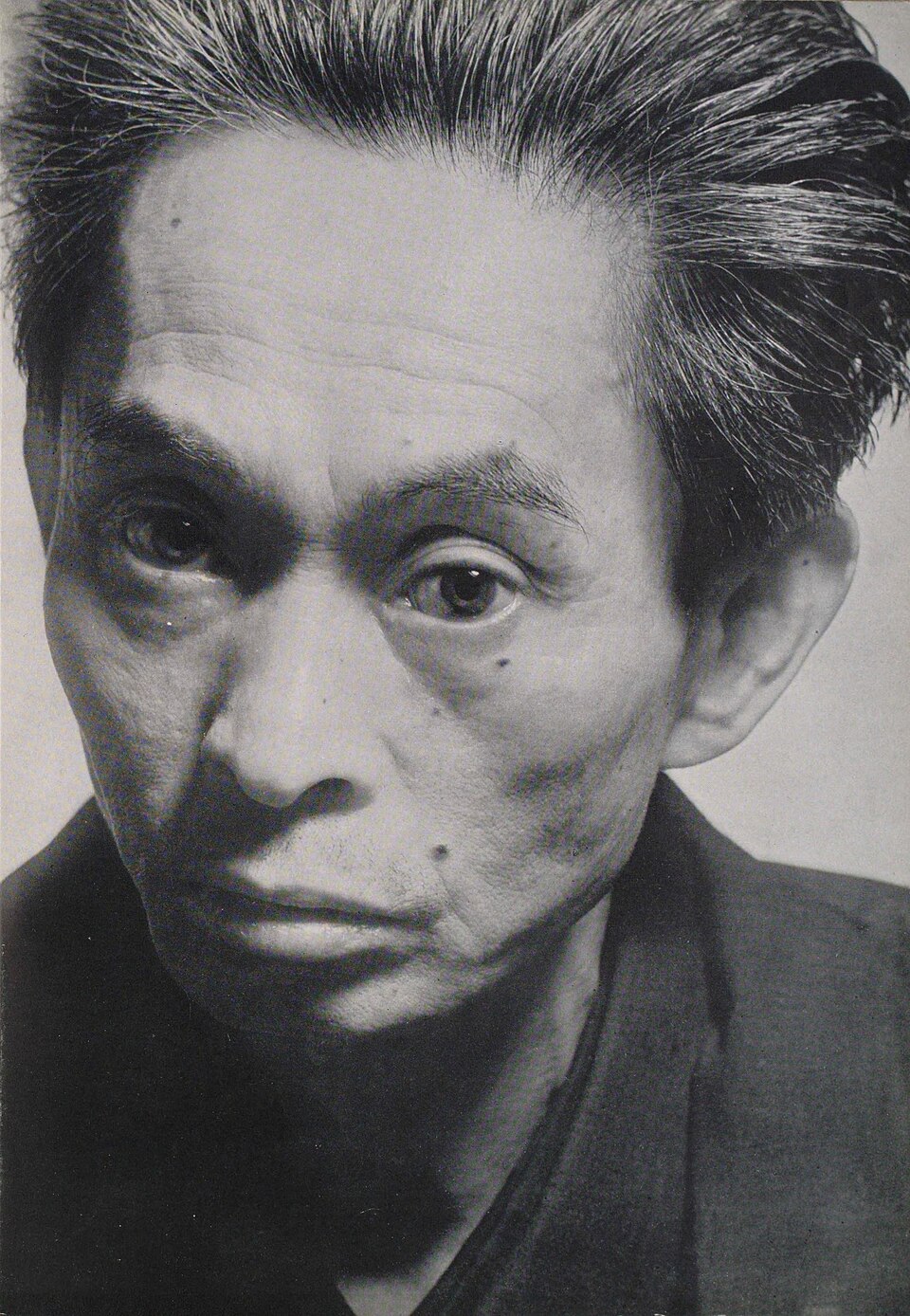
Photograph: Ken Domon · Commons marks it Public Domain
In 1968, he became the first Japanese writer to receive the Nobel Prize in Literature. The Swedish Academy honored the sensitivity and narrative mastery with which his fiction expressed a distinctly Japanese inner world.
The lecture has endured for more than the historic position of its speaker. When the first Japanese novelist to stand on the Nobel stage had to speak to the world about “Japan” and “myself,” he did not begin with national institutions, modernization, or literary schools. He chose the moon, snow, flowers, ink painting, gardens, and the tea room.
These were not arranged as a cabinet of unrelated Japanese curiosities. As the lecture unfolds, a shared way of seeing gradually emerges: how a limited thing before the eye can open onto a world that has not been fully shown.
From ink painting into a garden
Before Kawabata enters the Japanese garden, he pauses before an ink painting.
An ink painting does not fill every part of the paper. Space, abbreviation, and what remains unpainted are not simply missing content. Where no ink has been laid down, the wind may still have a direction, distant mountains may still have depth, and the viewer’s imagination can continue beyond the picture.
Kawabata then invokes Ikenobō Sen’ō, a master of flower arrangement: with a spray of flowers and a little water, one can evoke the vastness of rivers and mountains. The Japanese garden enters the lecture from here. It does not need to bring the whole of nature before the eye. From a few stones, a little water, trees, and open ground, it can awaken a sense of nature far larger than the garden itself.
A Japanese garden does not simply shrink nature and carry it inside a wall. With limited stones, water, trees, and open ground, it calls forth the nature beyond the garden.
The idea is easy to state. To make it work as a garden is extraordinarily difficult. The fewer the elements, the less room there is for uncertainty in the position, direction, or distance of any one of them.
Why does less make a garden harder?
In the lecture, Kawabata contrasts symmetry with asymmetry. He suggests that the asymmetry of a Japanese garden can evoke a broader, more complex natural world than symmetry.
But he immediately adds a crucial condition: this asymmetry must be held in balance by an extremely delicate and subtle sensibility.
Asymmetry, then, is not randomness. It is not the deliberate act of setting things crooked, nor the abandonment of order in order to look “natural.” There is still an order, but it does not announce itself through mirror images, a central axis, or repeated patterns.
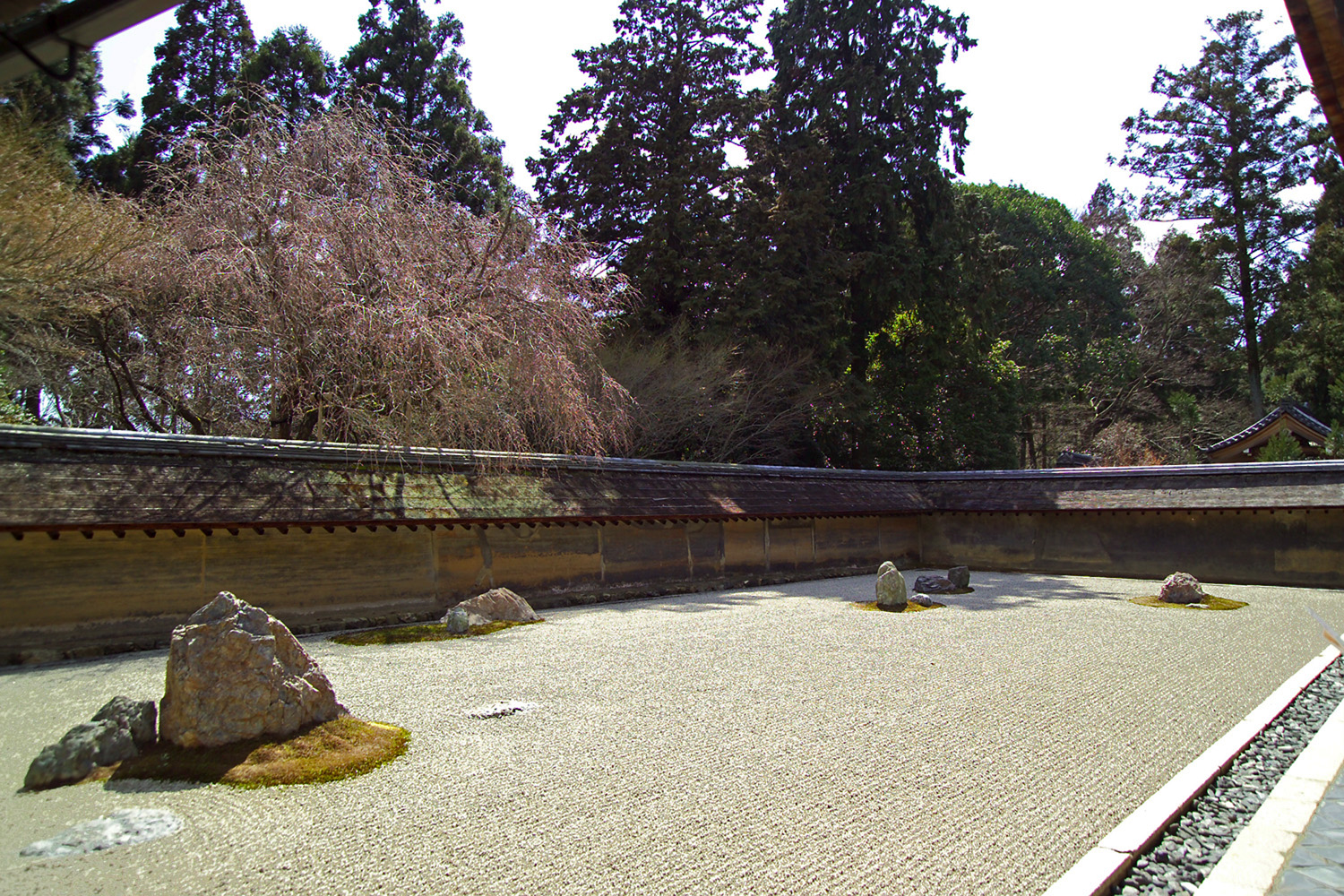
A dry landscape garden may appear to contain very little. Yet the direction, visual weight, spacing, and mutual response of every stone—and the tension between stone and open ground—must all be judged with care. The less there is on the surface, the more concentrated the judgment behind it must be.
A symmetrical composition can often be grasped quickly. Its center, axis, and corresponding sides allow the eye to arrive at a complete answer. An asymmetrical arrangement keeps the gaze moving from one stone to another and across the space between them, still searching for a relationship that has not been fully stated.
Kawabata’s sense that asymmetry can evoke a broader and more complex world may begin in this state of not being completely closed. Because the garden does not disclose every relationship at once, seeing does not end with the first glance. From here, his turn to karesansui follows naturally.
Karesansui is not a miniature of nature
Kawabata writes that a karesansui, or dry landscape garden, can use rocks and stone arrangements to express mountains and rivers that are not physically present. It can even make one feel the force of rough sea waves striking a cliff.
This is why karesansui is not a miniature model of nature. A garden stone need not resemble a particular mountain. White gravel is not merely a substitute for water. Stone and gravel provide direction, distance, rise and fall, and force. Through them, the viewer senses another world that has not been directly depicted.
This goes beyond the familiar idea of “seeing the great within the small.” That phrase can still suggest a scale model: a small object represents a larger one, and the garden becomes a reduced version of nature.
Kawabata’s account comes closer to making what is absent perceptible. The stones provide enough clues, but the mountains and rivers are never fully constructed. The other half of the garden must be completed within the viewer.
Precisely because nature has not been completely stated, the senses can move beyond the walls of an enclosed garden.
From a garden to a tea room and a single flower
Kawabata does not stop at karesansui. He says that when the Japanese garden is condensed to an extreme, it becomes bonsai or bonseki. The same sensibility then enters the small, austere tea room and finally arrives at a single flower.
This is not a sudden change of subject from gardens to tea. It is the same way of making meaning, carried into everyday life. The tea room is physically small and its contents are strictly limited, yet Kawabata finds in it a sense of boundless space and inexhaustible grace.
「一輪の花は百輪の花よりも花やかさを思はせるのです。」 A single flower can suggest greater splendor than a hundred flowers.
Kawabata continues: the alcove of a tea room often holds only one flower, usually a bud not yet fully open, moistened with dew. From a few drops of water come the air of morning, the season, and the time still ahead before the flower opens.
A hundred flowers in full bloom display their splendor before us. A single bud leaves something yet to happen. The viewer sees not only the flower that is present, but imagines how it will open and how an entire season is approaching.
It is the same principle by which a garden without flowing water can still make water felt. A limited form need not narrow experience. When the relationships are right, restraint allows the imagination to travel farther.
Looking again at a “Japanese-style” garden
Today, it is not especially difficult to make a space immediately recognizable as Japanese.
Stone lanterns, white gravel, moss, black pine, bamboo fences, and a tsukubai water basin form a clear visual vocabulary. Bring them together, and a photograph can quickly acquire a Japanese appearance.
But Kawabata did not assume that preserving traditional forms would automatically preserve their spirit. In the same lecture, he carefully explains that Thousand Cranes is not a celebration of the tea ceremony. He presents it instead as a work of criticism and warning against the vulgarity into which the tea ceremony could fall.
A garden is no different. Placing Japanese elements in a space is only the beginning. The harder questions are whether the stones form delicate yet stable relationships; whether the open ground has direction; whether asymmetry still holds a balance; and whether a finite site can make one feel a natural world larger than the site itself.
The next time we enter a Japanese garden, there may be no need to begin by counting its lanterns, gravel, moss, or pines. It may be better to remain a little longer and notice where the eye is led: how one stone draws another into relation, whether an open interval lets the gaze continue, and whether mountains and water absent from the garden can nevertheless be felt.
What Kawabata was describing may not have been a way to shrink mountains and rivers, but a way to keep a small garden from ending at its own boundaries.