When Steve Jobs was growing up, broad stretches of the Santa Clara Valley were still covered in apricot and plum orchards.
In a 1995 oral history interview, he recalled moving to Mountain View with his parents when he was five. The air was so clear that he could see from one end of the valley to the other. “It was really paradise,” he said—the best place in the world to grow up.1
Sixteen years later, Jobs brought that remembered landscape into a new setting. Presenting Apple’s future campus, he spoke of orchards, oaks, walking paths, and a building set within the landscape rather than dominating it.
The story begins before the circular building.
A Workplace for Meeting—and Stepping Away
Apple Park began as an idea about how people should work together.
When Jobs opened Pixar’s new headquarters in 2000, he had already described what he wanted from a workplace. Bringing people who had been scattered across four buildings into one would help colleagues who had never met encounter one another naturally. A central space would work like a town square, encouraging conversation and collaboration. Outside, a park would give people somewhere to get away when they needed to.2
People need to meet. They also need to step away. For Jobs, both belonged to the working environment.
About four years later, Jony Ive recalled, he and Jobs began discussing Apple’s future headquarters while walking through Hyde Park in London. The ring-shaped main building came later. They first imagined a campus where, wherever a person went, the immediate feeling would be of being in a park. Building and landscape would always meet.3
The circle came later in the story; the park was there from the beginning.
By 2011, Jobs was ready to take that idea before the Cupertino City Council and express it as a land ratio anyone could understand.
Reversing the 80/20 Split
On June 7, 2011, Jobs appeared before the Cupertino City Council. There were no keynote lights and no audience waiting for the next iPhone. He brought before-and-after views of a piece of land.
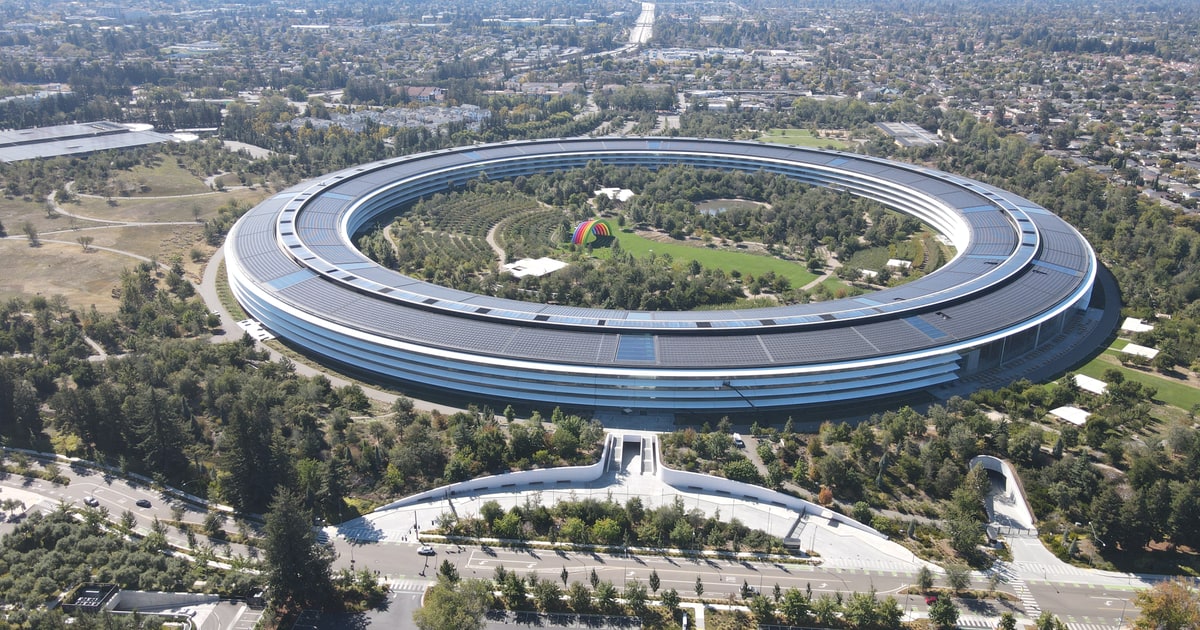
On one side were the offices, roads, and broad parking lots left by Hewlett-Packard. On the other, a vast ring-shaped building sat among trees and grass. Jobs joked that it looked a little like a spaceship had landed.
People did remember the “spaceship.” Yet another change he proposed that day was even more fundamental. About 80 percent of the existing site was covered by buildings and pavement, leaving only 20 percent as landscaped green space. Jobs wanted to reverse the ratio completely: 80 percent would become open green space, while buildings and other constructed areas would occupy the remaining 20 percent.4
The aim was larger than improving the existing patches of landscape. It changed what the land was primarily for.
The offices scattered across the site would be consolidated into the ring. Parking that consumed large areas of ground would move underground or into parking structures. The surface could then become woodland, meadow, orchard, paths, and a pond.
Apple Park covers about 175 acres, or 71 hectares. At the time, Jobs also proposed increasing the number of trees on the site from 3,700 to 6,000.5
Jobs died a few months later. The council presentation became one of the last public appearances people would return to again and again.
That day, he established a decision that came before the building’s form: first decide what kind of environment employees should work in, then place the building within it.
But changing the ratio on paper was only the start. The orchards, meadows, and tree canopy still had to be grown. That work began with the oaks Jobs noticed on his walks.
How Steve Jobs Looked at a Tree
Jobs liked to walk the rolling hills around Stanford Dish, where hundreds of native California oaks grow along the route. He did more than notice them. He asked someone to find out who had helped care for them.
The search led to arborist David Muffly. When Apple called, he was in the backyard of a Menlo Park home, doing a $125 lemon-tree pruning job.6
Less than twenty minutes into their first meeting, the conversation settled on the same landscape. Jobs wanted the new headquarters to become a miniature of the old Silicon Valley. Before technology companies filled the region, the Santa Clara Valley had orchards, grasslands, and broad stands of oak. Fruit trees outnumbered engineers.
A few months later, Jobs suddenly asked Muffly, “Have you seen it?” He led him into a room filled with campus presentation boards. Almost everything around the ring was green. Jobs soon left, leaving Muffly alone with the drawings.
Muffly later recalled that hundreds or even thousands of people would work on the building. The tree work seemed to rest on the shoulders of him and a small group of partners. The call that reached him beneath a lemon tree had given him the task of turning the valley Jobs remembered into living trees across an entire campus.
Jobs’s interest went beyond wanting “a lot of trees.” In 2011, Muffly stood with him in the backyard of Jobs’s home and asked him to choose between two trees in neighboring gardens. Jobs looked up for a moment, then pointed to the one Muffly believed had the better structure and hoped he would choose.
Muffly later said that Jobs had a sharper eye for tree form than many arborists. He could see whether a tree had a good framework.6
That attention to trees also followed Jobs beyond California. He visited gardens in Kyoto repeatedly, and those places held an important position in his aesthetic life. We explore that relationship separately in Steve Jobs and Saihoji: A Garden Beyond a Single View.7
Those visits show what held Jobs’s attention. In Cupertino, it settled on very concrete things: the framework of a tree, the course of a walking path, and what a person would experience when moving from indoors to outside. The work of building the campus belonged to Foster + Partners, OLIN, Muffly, and Apple’s wider team.
Muffly answered where the trees would come from. Landscape architect Laurie Olin had to answer how those trees would become a park people actually used each day.
“Anything Modern”
In the spring of 2011, Olin visited Jobs at home. Jobs was too ill to go to the office. When Olin entered the living room, he first noticed a large volume of Ansel Adams landscape photographs on the table.
Jobs told Olin that he had been looking for “the young landscape architect who is the next Olmsted”—someone capable of shaping a large landscape with landform, trees, and paths, as Frederick Law Olmsted had done as one of the designers of New York’s Central Park. Olmsted had also prepared a plan for Stanford, and Jobs repeatedly brought up Stanford’s Main Quad.8
Olin was already seventy-three. He had to wonder what Jobs meant by “young.”
Later in the conversation, Olin asked which kind of landscape Jobs disliked most. One of the defining figures of modern technology answered, “Anything modern.”
Olin could not resist: “But you’re the most modern person there is.” Jobs offered no explanation. He simply repeated, “Anything modern.”8
The contradiction becomes revealing at Apple Park. Jobs wanted the landscape to recede from declarations of modernity and let oak woodland, orchards, grass, landform, and paths become an ordinary daily environment.
At Jobs’s suggestion, Olin moved to Palo Alto for four months and revisited the natural and designed landscapes of Northern California. The direction he and Jobs established joined health and ecology with the region’s oak woodland, orchards, meadows, and local memory. Olin emphasized that Apple Park expressed the landscape of this region rather than copying any single place.8
OLIN reshaped what had been a flat site dominated by offices and asphalt into rolling ground. Woodland, meadow, orchard, walking and cycling paths, and the garden and pond inside the ring became parts of one system.9
Olin said that he and Jobs wanted the landscape to offer employees a place to step away. Jobs himself often worked through ideas by walking and especially liked to walk in nature. He imagined Apple employees being able to do the same.3
Later research gave that design judgment a clearer footing. A systematic review of nature-based interventions in actual workplaces found broadly positive relationships with mental-health measures and cognitive function. A meta-analysis of natural window views found associations with better psychological and physiological outcomes.10
After a meeting, someone can walk beneath the trees. At lunch, they can step outside. When an idea stalls, their eyes can move from a screen to the canopy. Green space allows encounters, walks, brief retreats, and renewed attention to recur throughout the workday.
The orchards and oaks Jobs wanted to bring back no longer belonged only to the past. They became part of what Apple employees see, walk through, and work beside each day.
From 6,000 Trees to 9,000
Once the vision met the land, the problem became enormous.
Muffly spent about a year examining nearly four thousand trees already growing on the site. In the end, he judged only about one hundred worth moving—and said that reaching even that number had been a stretch.
At the same time, the campus tree target rose from the 6,000 Jobs had announced publicly to 9,000.6
Apple needed more than young trees. The perimeter had to form a green screen early, which required trees that already had substantial height and canopy. Muffly first considered redwoods at abandoned Christmas tree farms around Skyline. The ground there was too rocky, and the trees had not reached the size Apple needed. The search moved farther outward.
The team eventually found two abandoned Christmas tree farms in the Mojave Desert, at Yermo and Adelanto. Even Muffly was surprised. Who would expect Christmas trees to have been grown in the desert? Apple eventually bought the Yermo site.6
This may be the clearest image of Apple’s financial power: it could extend a search into the desert, then buy the land.
Finding the trees solved only half the problem. Preparing them to move would take years.
Moving a large tree cannot begin a few days before the crane arrives. A common arboricultural practice is to prune the roots in advance, encouraging a denser network of fine roots within the future root ball. During the move, branches and foliage must be secured and the canopy protected while the crew preserves as much of the root ball and moisture as possible. After planting, the tree still has to extend new roots into the surrounding soil.11
A large, fully formed tree must adjust its water balance, rebuild its root system, and slowly spread its canopy again. A crane may place it on the new site in a day. When the crane leaves, the crown above ground can already make the landscape look mature. Underground, the roots have barely begun.
An $85 Million Permit Valuation for Landscaping and Irrigation
In its analysis of publicly available permits, the construction data site BuildZoom listed an approximately $85 million permit valuation for landscaping and irrigation among the ten largest permits associated with Apple Park’s main building.12
Permit valuations may be estimated or rounded and do not represent Apple’s final project cost.
Its scale covers far more than plants. Site preparation, grading, soil, irrigation, nursery cultivation, transport, planting, and continuing care all made it possible for thousands of trees to live in one campus. Landscape was a core construction project from the beginning.
Foster + Partners architect Stefan Behling recalled that Jobs regarded trees as some of the most beautiful works of art. Jobs would also say that no matter how wealthy a person was, they could not buy a truly old and beautiful tree.13
Apple’s resources could move parking underground, carry the search for trees into the Mojave, and begin preparing soil, irrigation, and nursery stock years in advance.
Money could prepare the ground and support years of care. Age would still arrive one growing season at a time.
Opening Day Was Only the Beginning
When the 2011 presentation ended, the ring, orchards, and oak woodland still existed only on drawings. Jobs died before the campus opened. In 2017, Apple announced that employees would begin moving in that April, while construction of the buildings and parkland would continue through the summer.14
The building was ready for occupancy. The park was just beginning.
Tim Cook later called Apple Park a “hundred-year decision.” The phrase placed the campus on a longer scale. Apple had chosen both the form of a building and the way a piece of land would accompany generations to come.13
Most of the orchards Jobs remembered from childhood had already given way to cities and technology companies. Apple Park translated that lost landscape into a contemporary workplace, returning orchards, oaks, paths, and shade to the valley’s daily life—and placing them at the center of a technology company’s working life.
Jobs left behind a judgment about the working environment: what someone sees outside the window, where they can walk before the next meeting, and whether the day contains somewhere for attention to settle again all deserve to be decided at the beginning of a headquarters plan.
Giving 80 percent of the land to green space wrote that judgment into the ground.
From the air, Apple Park is defined by the ring. At ground level, employees pass trees that are still growing, shade that is still forming, and a park that will keep changing with the seasons and the years.
Employees began moving into Apple Park in 2017. The oaks, orchards, and meadows around them were still young; they would keep growing for decades.
