A Wooden Tub Opens, and the Day Begins
When I was a child, breakfast was often either a scallion pancake or a Taiwanese rice roll, known as fantuan.
At the breakfast stall, steam and the smell of hot sticky rice rose as the vendor lifted the lid of the wooden tub. The rice was spread out, filled with a crisp fried dough stick, pork floss—finely shredded dried pork—and preserved radish, sometimes with a soy-braised egg as well. Then the vendor used a cloth to roll and press it into shape.
It was warm in my hand, with a reassuring weight. The rice was soft and sticky, the dough still crisp, the radish and pork floss savory. By the time I finished it, I felt full and ready for the day.
The rice rolls I grew up with made their purpose plain: hot, fragrant, filling. You could eat a complete breakfast without finding a table or reaching for a bowl and chopsticks.
Later, as I became more familiar with Japanese onigiri, I began to see how a meal held in one hand could have a different character.
Two Ways to Hold a Meal
In the simple Japanese onigiri I came to know, the rice stood out.
The filling might be pickled plum, salmon, or seasoned kombu, a type of kelp, with a little salt on the rice and perhaps a sheet of nori, the thin seaweed wrapper. Rice, salt, seaweed, and filling each had room to stand out. A mouthful did not need to be crowded with ingredients for the flavor of the rice to come through.
The Taiwanese breakfast rice rolls familiar to me brought together sticky rice, crunchy fried dough, and generous fillings. These simpler Japanese rice balls struck a lighter balance between rice and filling. Each made sense within the meals and mornings that had shaped it.
In Japanese, rice balls are commonly called onigiri (おにぎり) or omusubi (おむすび). Onigiri brings to mind nigiru, to grasp or shape with the hands; omusubi is often associated with musubu, to tie or connect. The names are largely interchangeable today, and their origins have several explanations. Yet the two actions offer a fitting way to think about a rice ball.1
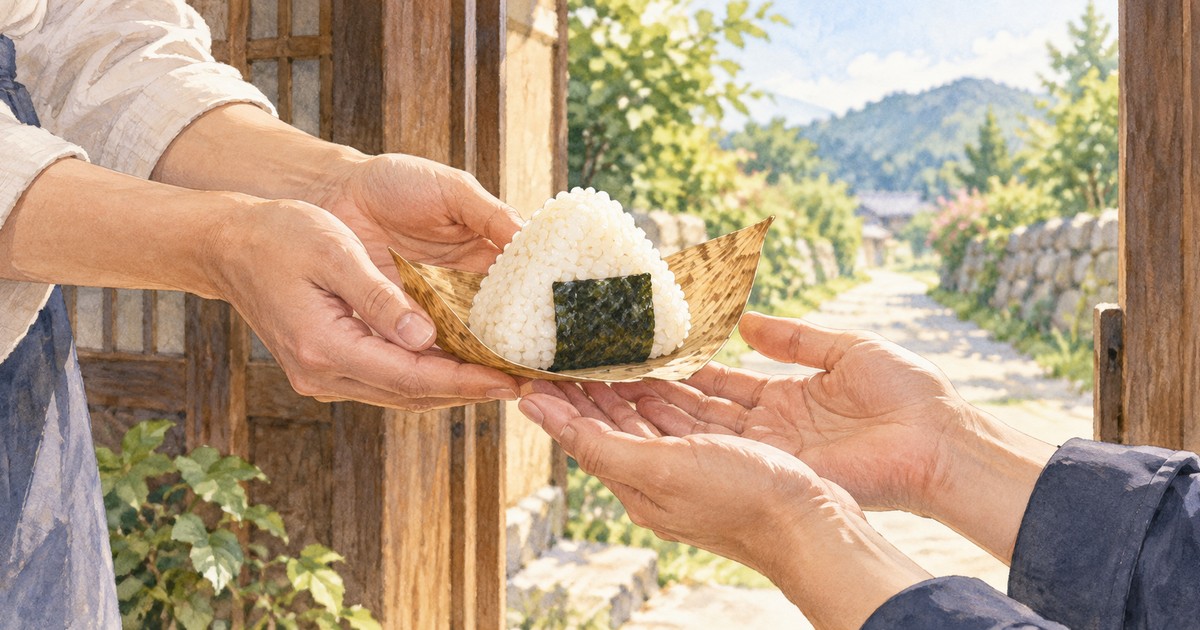
First, someone gathers the rice into a shape that can be carried. Then it passes from one person's hands to another's.
One traditional explanation links the triangular shape to mountains and the deities believed to inhabit them: rice was shaped like a small mountain as a wish for protection. This is one story about onigiri's beginnings; practical explanations for the shape also exist. Within that story, a small parcel of rice carries a hope for a safe journey.2
Round, triangular, or oval, the hands are doing much the same thing: turning a bowl of rice into food that can leave the table.
And so the rice ball goes on the road.
Bamboo Wrapping, Railway Stations, and Plastic Film
In Edo-period Japan (1603–1868), travelers, pilgrims, merchants, and people working in the fields all needed food they could take with them.
Picture a traveler with a pack, stopping by the roadside when tired. The bamboo sheath comes open. A few mouthfuls of rice, some pickled plum or daikon, a drink of water, and then the journey resumes.
What mattered was having a meal that traveled well and was there when needed. Onigiri belonged to the moment when someone still had a long way to go.
The need for food on the road was familiar in ancient Rome, too. In Satires 1.5, Horace describes a journey in the first century BCE, noting that experienced travelers stocked up on good bread before reaching a town where it was gritty. In the first century CE, Seneca describes traveling with dried figs, eating them with bread when he had it and on their own when he did not. Bread and figs, or rice wrapped in bamboo: each gave a traveler something to eat between stops.3
During the Meiji era (1868–1912), the expanding railway network changed how people traveled. Rice balls made their way from travelers' bundles into railway stations.
Station lunch boxes became known as ekiben (駅弁). One frequently cited early example consisted of two rice balls and slices of pickled daikon wrapped in bamboo sheath. Today, ekiben can offer regional specialties, elaborate side dishes, and beautiful packaging. That modest early example was rice prepared for a journey.4
Each era found its own answer to the same question.
Bamboo wrapping served people traveling on foot; ekiben provided a meal for a train journey. Convenience stores took the problem into finer detail: how could the rice stay soft, the seaweed stay dry, and the package open without leaving rice all over the eater's hands?
In 1978, 7-Eleven Japan introduced its "Parikko Film" packaging, which kept the nori separate until it was time to eat. The packaging continued to evolve. In the familiar version used today, you pull the strip along the marked line, slide the film away from each side, and bring the seaweed against the rice just before the first bite.
The motions are so familiar that we rarely pause over them. That little package depends on careful design, preparation in large batches, and temperature control during delivery and display. On the way to work, school, or a train, someone can open it and still find soft rice and crisp nori.5
From bamboo sheath to station lunch box to plastic film, the wrapping keeps changing. The question remains:
Once we leave the table, how can we still have a proper meal?
From the Shelf to the Hands, and Back to the Street
Convenience stores made onigiri something readily available throughout the day. Onigiri specialty shops have also brought the making of a rice ball back into view.
At some shops, the staff begin shaping the rice only after an order is placed. They lift warm, freshly cooked rice, add a filling, and gently bring it together. Some serve miso soup, small side dishes, and tea. Others seat customers at a counter where they can watch rice, filling, and nori become a meal.6
There is an interesting turn here. A food so well suited to leaving the table is also bringing people back to one.
Convenience stores make onigiri quick to buy. Specialty shops let us see the hands that the packaging usually hides.
Others have taken onigiri back onto the street.
In Hiroshima, Kaho Higashi started that’s rice with a handcart made by her grandfather. She prepared rice balls in a shared kitchen before taking them through the city to sell. A reporter who visited her in early 2025 described the work of cooking, shaping, and packing that began before dawn.89
In an interview with Hiroshima Starters, she traced the idea to a handcart selling traditional sweets that she had seen in Fukuoka. She first considered selling the same kind of sweet. But she loved onigiri, felt that people of all ages could enjoy them, and saw an opportunity to sell them in Hiroshima.7
On the street, a meal could become a chance encounter. In the 2025 report, a bell attached to Higashi's cart rang as it crossed slopes and uneven ground. Customers stopped to ask what she recommended, offer encouragement, or buy because they felt lucky to have found her.9
Her grandfather's work was there in the cart itself. The customers she met gave the business another kind of support. Writing on her own website, she described how walking through the city and handing rice balls to people one by one had gradually changed the way she thought about her work.8
Convenience stores bring onigiri to shelves. Higashi's cart brought them into people's paths. Both make a meal available beyond the dining table, ready to be placed in someone's hands.
Her business has since gained a permanent home: the shop's website records its opening on July 25, 2026.8
A Meal When You Need It Most
Onigiri often appears while someone is in the middle of doing something else.
Going to school or work, traveling, training, or simply being too busy to sit down for lunch: a rice ball slips a meal into the space between one thing and the next.
The idea of food restoring someone's strength takes a quieter form in film.
In Hayao Miyazaki's Spirited Away, Chihiro has been thrown into an unfamiliar world of spirits. Her parents have turned into pigs, and everything around her is frightening. Haku gives her rice balls.
As she eats, she begins to cry.11
The rice balls cannot solve what has happened to her. They let a child who has been holding herself together finally eat and feel that someone is looking after her. Then she can begin to face what comes next.
In Kamome Diner, onigiri has a different part to play.
A Japanese woman opens a small diner in Helsinki, Finland. She makes onigiri central to the place, where it is presented as Japanese "soul food": food that can bring home and familiar habits to mind.12
Chihiro's rice balls reach someone close to breaking down. Those in Kamome Diner give people far from home a place to sit and gradually recover a familiar rhythm.
One helps a person carry on; the other gives them a place to pause. Both begin with the same small act: making sure someone has eaten.
Rice, Hands, and a Road Ahead
Looking back, there is no single shape this meal has to take.
At a Taiwanese breakfast stall, it may be hot sticky rice, a crisp dough stick, and a substantial weight in the hand. In a simple Japanese onigiri, it may be the balance of rice, salt, nori, and filling. A convenience store keeps rice and seaweed apart with film; Kaho Higashi began by loading rice balls onto her grandfather's cart and pulling them through city streets.
The form changes. What connects these meals is the act of handing the rice over.
Someone shapes rice into something that can be carried, then gives it to a person who is about to leave home, still on the road, or unable to find a table for the moment.
A rice ball is small. Yet it holds the rice, the work of someone's hands, and something for the road ahead.
It also holds a simple wish: to leave home and still eat well.
A meal that fits in your hand, giving you the strength to keep going.