Why Is the Garden More Than a Backdrop in a Japanese Home?
How the direction a room faces, where we sit, and the engawa bring the garden into everyday life.
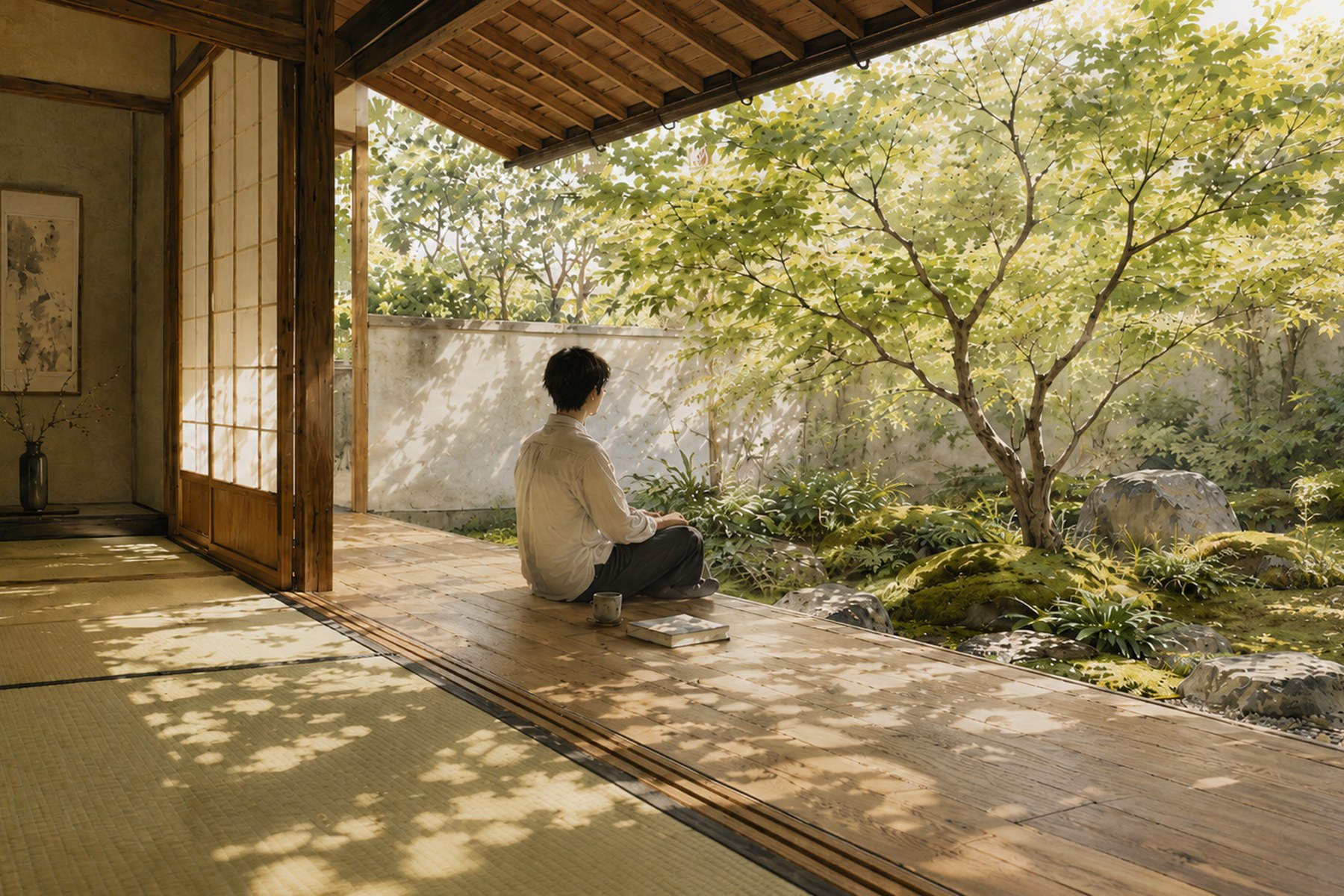
The first time I visited Ryōgen-in, a subtemple of Daitoku-ji in Kyoto, I knew very little about Japanese gardens. I no longer remember which stones or trees I saw that day. What has stayed with me instead is the feeling of sitting on the engawa veranda, facing the garden.
Once I sat down, I no longer felt any hurry to move on to the next place.
At the time, I probably thought the garden was simply so beautiful that I did not want to leave. Looking back, however, my memory also holds the deep eaves overhead, the post beside me, the wooden floor beneath my feet, and the dim room behind me.
What remained was not only a garden, but a space formed by house and garden together.
House First, Garden Later
In the residential planning I have encountered in Taiwan, the discussion usually begins with the building. Its mass, rooms, parking, circulation, and regulatory requirements are settled first. The garden is arranged afterward.
This is practical. But once the orientation of the rooms, the position of the doors and windows, and the paths people take through the house have all been fixed, it becomes difficult for the garden to change where people look, where they sit, or how they approach the outdoors each day.
I remember Professor Takashi Awano once telling me that in Japanese architecture, garden and building are equally important—and that sometimes the garden is even more important. He also used the phrase teioku ichinyo (庭屋一如), “garden and house as one,” to describe their relationship.7
The phrase speaks of house and garden as a single whole. His suggestion that the garden may sometimes matter even more than the building placed it earlier in the planning sequence than I was accustomed to.
What can a garden do to carry that much weight?
The Garden Begins with the Floor Plan
Some surviving shoin-style reception rooms, hōjō halls—abbots’ quarters at Zen temples—teahouses, and residences show that house and garden were not always completed separately and only then placed beside one another.2
Which room faces the garden, where a person is likely to sit, how large an opening is, and how far the eaves extend can all shape the placement of stones, plants, and distant views.
Even on the long, narrow plots of Kyoto machiya townhouses, a small tsuboniwa courtyard garden is often left between parts of the building. It may occupy little space, yet still affect daylight, ventilation, sightlines, and the relationship between spaces at the front and rear of the house.1
The house determines where we look from; the garden determines what we see once we sit down. Whether a room makes us want to linger often depends on what it faces.
Viewing the Garden from Inside
Some Japanese gardens are intended to be viewed primarily from inside the building.2
In photographs, the eaves and posts are often cropped away, leaving only stones, moss, trees, and white gravel. At the site itself, however, the architecture remains within the field of view.
Deep eaves screen out part of the sky, and the dimmer interior behind us makes the garden appear brighter. Posts and shoji screens frame the view. Seated on tatami, our viewpoint is lower than when standing, and the proportions among stones, ground, and plants look different.
The same garden may look entirely different from another room. Shift your body slightly and a stone hidden behind a post comes into view; a distant tree may re-enter the composition.
Some tatami rooms contain almost no furniture, yet they do not feel empty. The garden, the light, and the changing seasons have already become important parts of the room.
Everyday Life on the Engawa
Between house and garden lies the engawa, a transitional space. It joins the room on one side and opens toward the garden on the other. It can feel like part of the interior and, at the same time, as though one has already stepped outside.3
With eaves overhead and the house’s wooden floor underfoot, a person can remain sheltered from direct sun and rain while wind, sound, and the scent of plants still reach them. On the engawa, the house has not yet ended and the garden has already begun. The two do not stop separately at a door or window; they meet here.
The engawa is therefore more than a passage from the room to the garden. It is also a place to sit. Moving from the room onto it usually requires no more than sliding open a shoji screen and taking one step. However beautiful a garden may be, if each visit requires putting on shoes, opening a door, and deliberately going outside, it adds several small actions to daily life. The engawa shortens that distance.
Seen through a window, the garden is a view before us. Seated on the engawa, we have not fully entered the garden, but we can already spend time with it.
I first came to know the engawa through anime and Japanese television dramas. People sit there eating watermelon, drinking beer, talking, or simply doing nothing. In the television drama Hotaru no Hikari, Hotaru Amemiya treats the engawa as the place where she feels most at ease at home.4
Later, reading Natsume Sōseki, I learned that this same ease on the engawa had long appeared in Japanese literature. While living in London, Sōseki wrote to his wife that when he returned to Japan, he wanted to eat soba and Japanese rice, put on Japanese clothes, and lie in the sun on an engawa looking out at the garden. At the beginning of The Gate, Sōsuke carries a cushion onto the engawa, sits for a while, and eventually lies down.5
More than a century apart, the most comfortable posture on the engawa seems not to have changed.
When two people sit side by side there, they do not have to keep looking at one another. When the conversation falls quiet, there are still tree shadows before them and cicadas or rain to listen to. Silence does not feel awkward.
Without the garden before it, the engawa would still exist, but the life lived there would feel very different.
The Garden Changes the Room Every Day
After sitting on the engawa for a while, we begin to notice that the garden is not a fixed picture.
Morning and evening light differ. Clear days and rainy days sound different. Wind moves the branches, and shadows fall across shoji screens and tatami. After rain, the stones deepen in color. Once the leaves fall, things previously hidden behind them come into view.
Nothing new has been added to the room, yet the garden makes it slightly different every day.
In In Praise of Shadows, Jun’ichirō Tanizaki wrote about light in Japanese architecture. Direct sunlight is held at a distance by deep eaves and the engawa, while faint light reflected from the garden enters the room.6 The garden, too, participates in the room’s light and shadow.
It carries the changing light of the day, the weather, and the seasons indoors. A person does not have to step outside to know what is happening there.
How Far Is the Garden from Everyday Life?
Homes today have different structures, climates, and ways of living. A traditional timber engawa need not be reproduced unchanged.
But the questions it leaves us remain compelling: Which way do the main rooms face? What do we see after we sit down? How many actions separate the places we use each day from the edge of the garden?
Seeing a garden and being beside it are not the same. To be beside it is also to encounter wind, sound, scent, and temperature.
Wooden latticework, stone lanterns, and a dry landscape garden can create a Japanese atmosphere. Whether a garden truly enters everyday life, however, still depends on the relationship among rooms, doors and windows, eaves, and circulation.
Looking back at the residential planning familiar to me, Professor Awano’s words do not suggest that a Japanese home should simply be reproduced elsewhere. They remind me to ask whether, before the building has been fully determined, we might first consider what the garden could change.
Years later, when I think back to Ryōgen-in, I still remember the garden, the eaves, the post, the engawa, and the dim room behind me.
Together, they made me sit down. Together, they kept me from hurrying away.
At the time, I did not yet understand teioku ichinyo.
My body had already felt it.
People in Context
Sources and Writing Notes
- Kyoto City Cultural Heritage, “Kyoto Machiya and the Culture of Everyday Life”. On the placement of tsuboniwa and rear gardens within machiya, and their role in bringing air, light, and seasonal nature into the home. The English title is a descriptive translation by Tang-Yu Life.
- Rie Maki and Manami Fujinaka, “The Composition of Dry Landscape Gardens: Focusing on the View from the Room”, 2012; Seiro Harada, Junhwan Song, and Satoshi Shimizu, “Research on the Integrated Spatial Characteristics of Gardens and Porches Based on Measured Data: Focusing on 13 Temples in Kyoto Prefecture”, 2025. The two studies consider, respectively, views from the interior and measured spatial relationships among garden, architecture, and engawa. The English titles are descriptive translations by Tang-Yu Life.
- Japan’s Ministry of Land, Infrastructure, Transport and Tourism, “Promoting Wa no Sumai”. The initiative identifies engawa, tatami, and fusuma among forms of traditional residential knowledge rooted in local climate, environment, and ways of life. The English title is a descriptive translation by Tang-Yu Life.
- Nippon Television, official story page for Hotaru no Hikari. The essay draws on the series as a familiar cultural example of Hotaru Amemiya relaxing at home and spending time on the engawa.
- Natsume Sōseki’s letter to his wife, Kyōko, dated April 17, 1902, and his novel The Gate. See Tohoku University Library’s introduction to the letter, this paper in the Waseda University Repository, and The Gate at Aozora Bunko.
- Jun’ichirō Tanizaki, In Praise of Shadows. On deep eaves, the engawa, light reflected from the garden, and shadow within the room.
- Tokyo University of Agriculture | Takashi Awano researcher profile. The conversation described in this essay is recalled from the author’s memory and is not presented as a verbatim quotation.
English Version 1.0 · Prepared 2026.08.09 · Page format based on the approved Chinese article structure