When I first wrote about Nitobe Memorial Garden at the University of British Columbia in Vancouver, I focused on the pond, the stone bridges, and the garden itself. As I worked through the material, though, I kept returning to one detail: the bronze statue of Nitobe, made by the Taiwanese businessman Hsu Wen-long.1
The statue left me with a question. What connection did the man commemorated in this Canadian garden have with Taiwan?
Following his name took me to Ciaotou, in what is now Kaohsiung. Construction of the sugar factory at Ciaozaitou, as the place was then known, had already begun in February 1901. Nitobe submitted his Recommendations for the Improvement of Taiwan's Sugar Industry that September. The sequence changed the question I wanted to ask. If the policy paper had not brought the factory into being, what had made a factory consuming hundreds of tonnes of cane a day possible? Whose land and work had become part of its operation?
I wanted to use the brick buildings, tracks, and machinery that remain at Ciaotou to understand how the factory had changed farming, trade, and people's work. That was the question I began to follow.
Two developments in 1901
Taiwan's history of sugar production began long before Japanese colonial rule.
Small sugar works stood near fields and settlements. Oxen turned stone rollers to crush the harvested cane, and the juice was boiled down in large pans. Production varied in scale and was scattered across the island. Sugar was already an important export.
When Japan took control of Taiwan in the late nineteenth century, the colonial government saw opportunities beyond the island's existing skills in making sugar. Taiwanese production could meet Japan's demand for imported sugar and help support the colony's finances. Attracting investment, subsidizing equipment, and establishing agencies to oversee the industry became government priorities.
In 1900, Taiwan Seitō (Taiwan Sugar Co., Ltd.), a Japanese company, was established and chose Ciaozaitou for its first factory. Mitsui & Co. was its largest shareholder; the family of Chen Jhong-he, a sugar merchant from Takow, now Kaohsiung, also invested. The colonial government provided subsidies and administrative support. Water, land, and transport influenced the choice of site, and official assistance helped the company acquire land for the factory and its own farms.2
Construction began in February 1901. The factory started producing sugar in January 1902.
Nitobe had come to Taiwan in 1901 to investigate its sugar industry. His recommendations, submitted that September, treated cane varieties, cultivation, transport, crushing, and sugar manufacture as parts of a continuous process. His proposals extended to incentives, research, transport infrastructure, and government organization.3
The factory buildings were already under construction. Keeping their machines running year after year would also require changes in the surrounding land, cane supply, and transport. These were the points at which the two developments of 1901 gradually came together.
How much cane did one factory need each day?
The machinery is the most conspicuous part of a large sugar factory.
Inside, cane passes through crushing, clarification, evaporation, crystallization, separation of the sugar crystals from molasses, and packaging. Even in its early years, the Ciaozaitou factory could process 200 tonnes or more of cane a day, far beyond the scale of the older sugar works.5
But the greater the machines' capacity, the further the factory's requirements reached beyond its walls.
Where would hundreds of tonnes of cane come from each day? Who would grow it? How could the company ensure that the harvest reached its factory?
The crushing machinery stood at the end of a much longer process. To increase yields and secure a continuing supply, the colonial government gradually brought seed cane improvement, purchasing arrangements, and the allocation of cane to particular factories within the scope of sugar policy.
From 1905, the government began designating cane supply districts according to each factory's capacity. Revisions in 1906 made the system more comprehensive. Farmers within a district could still decide what to plant. If they chose sugar cane, however, they could no longer freely choose its buyer. The arrangement gave the company a more dependable supply and also required it to purchase cane from the district.4
Some people grew cane; others worked on company farms or operated the factory's machinery. Their positions and rights differed, but their work was connected by the factory's daily demand for raw material.
The machines turned cane into sugar. The rules determined where the cane came from and whom its growers could sell it to.
The railway connected the factory to a wider landscape
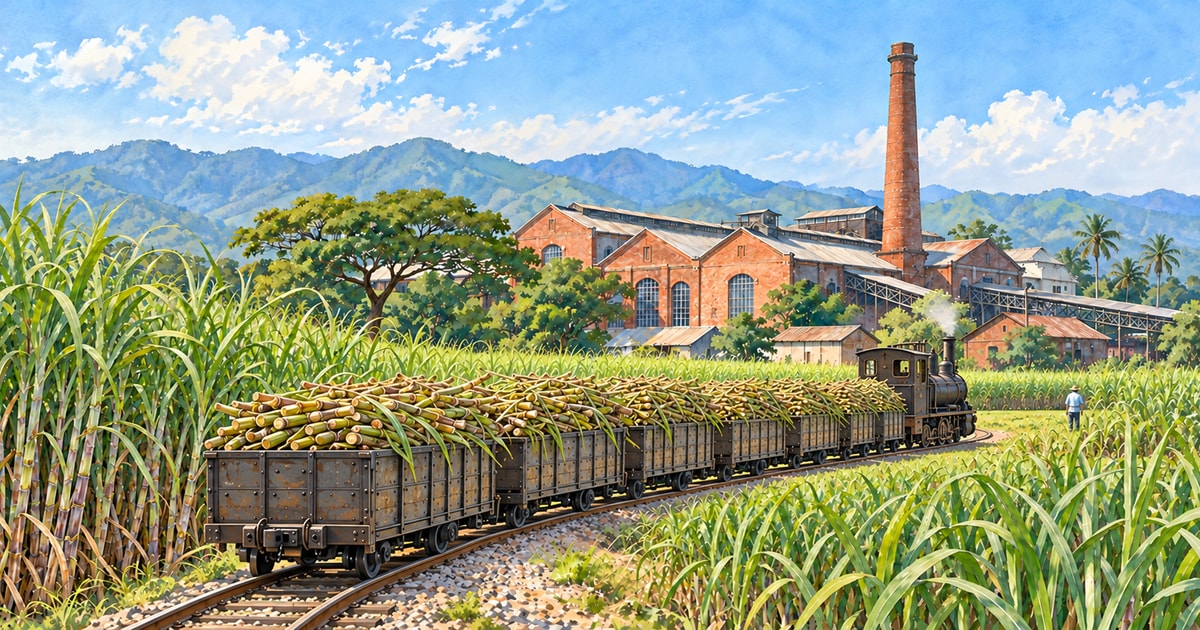
Supplying a factory that processed 200 tonnes or more of cane a day was difficult to manage reliably with ox carts alone.
Around 1907, a dedicated sugar railway with a track gauge of 762 millimetres began operating at Ciaozaitou, carrying cane into the factory and products out. The factory needed a transport network extending well beyond its buildings.
The gauge was roughly half that of standard-gauge railways, giving these trains their familiar Taiwanese name, wufenche. The sugar railways linked cane fields, factories, and the wider rail system, allowing large quantities of cane to arrive at the pace the machinery required.5
Offices, workshops, staff housing, a clubhouse, and religious facilities gradually appeared around the factory. As the railway, repair facilities, and residences gathered within the same company grounds, sugar production also drew maintenance, administration, and some employees' home lives into this space.6
The surviving crushing machinery, boilers, evaporators rising three storeys high, and interlaced pipes still convey the scale of processing hundreds of tonnes of cane each day. They also bring into view the many kinds of work, dispersed across the surrounding area, that lay behind a bag of sugar.
After the machinery stopped
The factory's ownership and administration changed abruptly in 1945. After Japan's defeat, the Taiwanese operations of Japanese sugar companies came under takeover and supervisory bodies. In 1946, the newly established Taiwan Sugar Corporation took over the Ciaozaitou factory. Postwar repairs followed, while railways, equipment, and staff previously belonging to separate companies were brought into a single organization.
In the late 1960s, automated central controls increased the factory's daily crushing capacity to 3,400 tonnes. The same factory had gone from processing around 200 tonnes a day to 3,400. Its machinery had changed, along with the company that ran it and the government under which it operated.
Sugar production ended at Ciaotou in 1999.
The factory survived. Its principal buildings and equipment were preserved, and the site became the Taiwan Sugar Museum in 2006.7
Here, history remains spread across the grounds. Visitors can walk between the factory, railway, offices, and housing and see traces of construction, expansion, closure, and preservation. What survives at Ciaotou is more than its distinction as Taiwan's first modern sugar factory.
New industry comes to Ciaotou
More than twenty years after the factory stopped making sugar, the surrounding area was again being developed through a national industrial plan.
The Executive Yuan, Taiwan's cabinet, approved Ciaotou Science Park in 2019. Infrastructure work and construction by incoming companies proceeded in parallel from 2022. The park held its official opening on January 2, 2026. On January 13, ATP Electronics inaugurated the park's first operating factory.8
The science park occupies a separate site from the preserved sugar factory. It lies within the second phase of the Kaohsiung New Town development, spanning Ciaotou and Yanchao districts. Before development, most of the land belonged to Taiwan Sugar Corporation, alongside other publicly and privately owned land. The connection between the two sites lies in the wider landscape: land held by the sugar company, and Ciaotou itself, was again being drawn into an industrial plan.9
More than a century ago, the factory's operations reached into cane fields, railways, staff housing, and settlements. Today's factories also depend on roads, energy, transport, and the places where people live. The science park is still in its early stages. Who will come to work here, where they will commute from, and how local life will change are questions whose answers are still taking shape.
By this point, I understood why I had kept returning to the statue. A monument to one person had drawn my attention to the cane fields, tracks, red-brick factory buildings, and the people whose work connected them.
Ciaotou's machinery no longer makes sugar. The factory, railway, and housing remain. As new industry enters the area, they leave me with a question: beyond the factory walls, whose land, daily travel, work, and lives are being rearranged?